
I, T, and X-shaped designers explained: Find your design identity

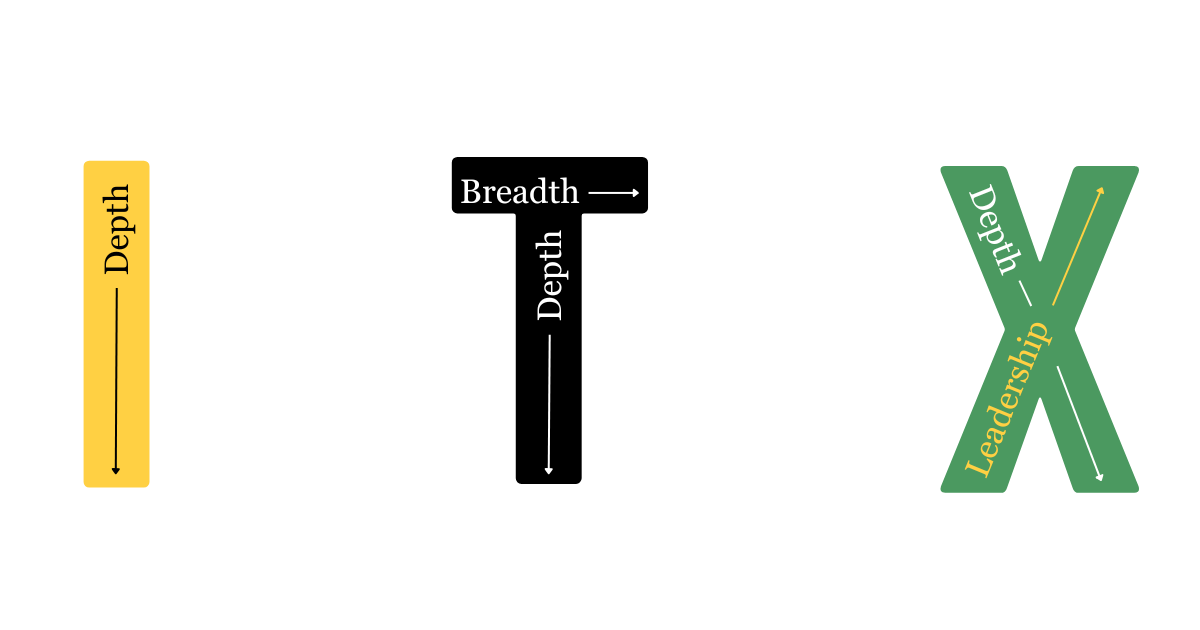
Today’s designers are often categorized as: I-shaped, T-shaped, or X-shaped. These models describe how deep and broad a person’s skills and collaborations are. Understanding these models can help you shape your future in design.
I-shaped: Deep expertise in one area (specialist)
T-shaped: Depth in one area + breadth in others (collaborator).
X-shaped: Depth, breadth, and leadership (strategist/leader).
While rooted in design, the framework is applicable across industries. Professor and Chair of Collaborative Design, Gayle DeBruyn, explains, “Everything is designed; our systems, our government, our things, even how we organize our families.”
I-Shaped Designer: Depth
I-shaped designers have great knowledge and depth in one specific area, such as graphic design or UX design. These designers are specialists with mastery in one specific area of design. Collaborative Design student, James Fischer, shares, “When I started at Kendall, I was an I-shaped designer. I had one field, which was interior design, and I was going to study all the things related to interior design.”
While this depth is essential, the complexity of work demands a broader understanding.
As DeBruyn notes, “People need to understand the consequences of their work. What
could happen if we thought bigger about the problem or brought more people together?”
T-shaped Designer: Breadth and Depth
T-shaped designers build upon the I-shaped model, combining in-depth knowledge in one specialty with a broad understanding of related disciplines. “As I started to have special interests in environmental studies and inclusive design,” Fischer explains, “I began to branch out into a T-shaped designer.”
As our world evolves, so must our practices. “We know the future of work is going to be how we interface with machine learning and we need to know how to grow with it.” says DeBruyn.
X-shaped Designer: Breadth, Depth & Leadership
X-shaped designers bring together expertise, interdisciplinary knowledge, and leadership
skills. “It took me until my senior year to really start to see myself as an X designer
because I started to combine all the projects I was working on across my classes,
which are in completely different fields.” Fischer explains, “You start to see and
build common threads between [subjects] that all speak to one another. That really
is what collaborative design is
all about.”
The Ferris State Kendall College of Art and Design Collaborative Design curriculum encourages students to pursue this expansive learning. DeBruyn states, “We need to be forward-thinking about where we’re going. Our students design by doing. We don’t sit in lecture and wonder about it–we try stuff out.” The program reflects the future of the design profession-one that moves far beyond traditional boundaries.