March 2, 2026
Ferris State Chemistry professor’s research with global impact published by international journal
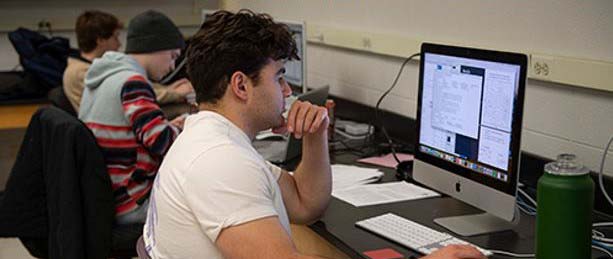
A Ferris State University Chemistry professor’s work understanding complex interactions in molecules has been published in an international journal that focuses on cutting edge research.
The work of Dr. Luis A. Rivera Rivera, a professor in Ferris State’s Physical Sciences Department, was published in The Journal of Chemical Physics, a prestigious publication that documents innovative research in all areas of modern chemical physics and physical chemistry.
Rivera’s work uses a combination of experimental data and theoretical calculations to understand complex interactions in molecules, like potential energy surfaces for weakly bound complexes.
This approach is called potential morphing – where accurate measurements are made using infrared lasers to measure potential energy surfaces – and a major focus of theoretical chemistry.
The study of potential energy surfaces has wide impact in molecular sciences and helps to unravel the mysteries of how molecules exist, their properties and reactivity.
Rivera and his students are working with top scientists across the globe on this research.
The research published in the Journal of Chemical Physics was done working with Dr. G. Barratt Park of Texas Tech University and the Max Planck Institute for Multidisciplinary Sciences, and collaborators at Deutsches Elektronen-Synchrotron DESY and Institut für Physikalische Chemie, Christian-Albrechts-Universität zu Kiel in Germany.
Their findings revealed an accurate potential energy surface for the Neon-Hydrogen Chloride (Ne-HCl), and shedding new light on how this approach can be used to predict new experimental data to be measured.
With the support of a $200,000 research grant from the National Science Foundation and in collaboration with Dr. Jay R. Walton of Texas A&M University, Rivera is developing a new theory to approximate potential energy surfaces.
This novel force-based canonical theory has demonstrated accurate and quantitative interrelations between weakly bound and strong covalently bound interatomic interactions.
The theory has been recently reviewed in their book: “Canonical Approaches to Interatomic Interactions: Theory and Applications,” published last year by Elsevier.
Rivera has mentored 15 Ferris State students and three high school students in research during his time at the university. He was also awarded a Mathematical and Physical Sciences - High School Supplement grant of $8,473 from the NSF to support two high school students to conduct research in his laboratory in 2024.
Rivera views his research program as a unique way for students at Ferris State to experience chemical research as part of the undergraduate curriculum.
“I consider undergraduate research to be an effective tool for teaching chemistry,” he said. “Undergraduate research experiences allow students to integrate and apply basic chemical knowledge to real-world problems; thus, providing the students with a broad-based education.”
In his Introduction to Physical Chemistry course, Rivera provides community service through the FSU Academic Service-Learning program. Partnering with Big Rapids Middle School and St. Mary Catholic School, CHEM 451 students helped enhance STEM education for middle school students.
As part of their Academic Service-Learning project, students instructed STEM experiments with middle school students. These hands-on experiences complemented and enhanced STEM education at local middle schools.
More than 350 middle school students participated in this NSF-supported project, which provided real-life, hands-on experiences in STEM education.
“I believe sharing the wonders of science earlier in life has the potential to impact middle school students' STEM curiosity, which in turn can influence their pursuit of STEM education at the college level,” Rivera said.