

July 22, 2026
Classrooms to Careers: Ferris State student's Diagnostic Medical Sonography internship leads to a job before graduation
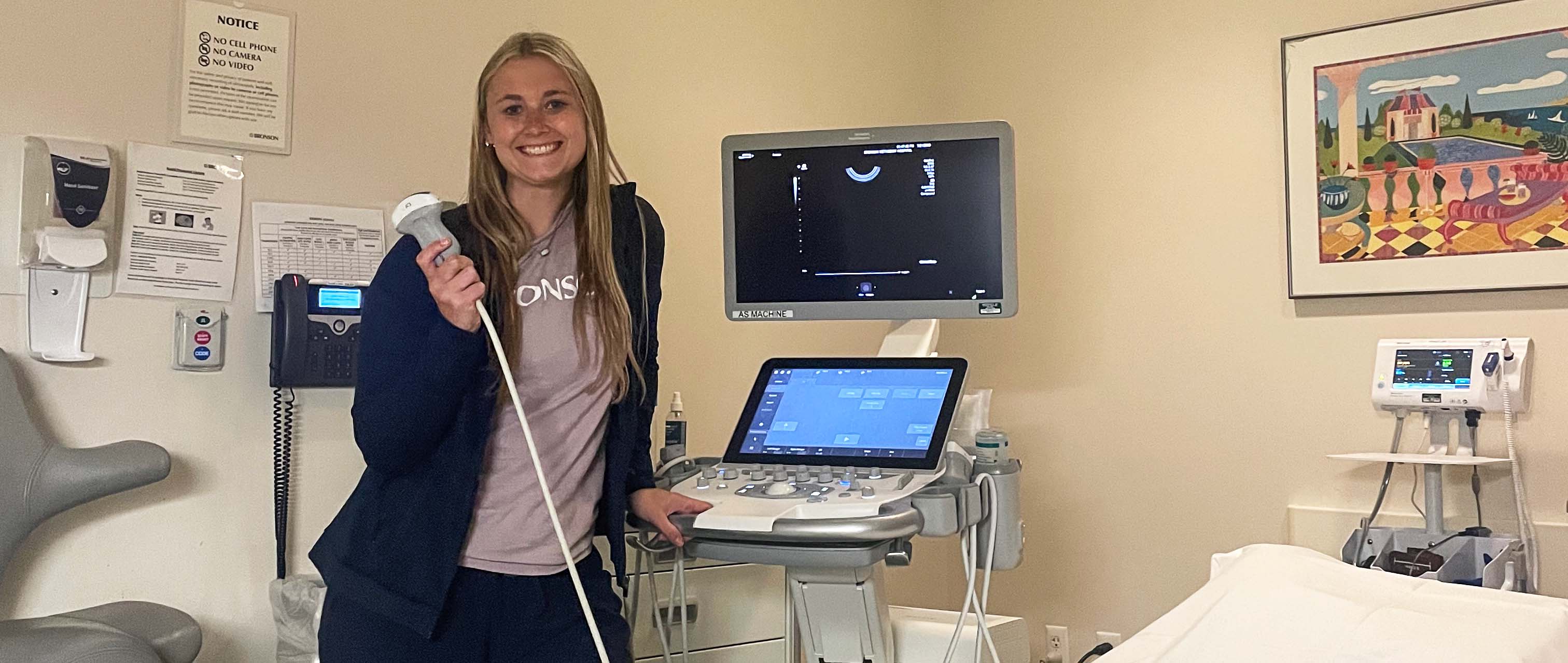
Payton Stahl already knows where she'll be working after graduation: the same hospital where she's finishing her internship right now.
Stahl, a Middleville native completing her final semester in Ferris State University's Diagnostic Medical Sonography program, started her clinical rotation at Bronson Battle Creek Hospital last August.
She moved to Bronson Methodist Hospital in Kalamazoo in February, after the hospital flagged an opening and offered to let her train at the site where she'd eventually work full time.
Growing up with a family of nurses, Stahl expected to follow that path herself. That changed in high school, when a health class and a nurse-tech internship at the Kent Career Technical Center prompted her to consider another direction. A career-exploration assignment steered her toward ultrasound instead, and a job shadow confirmed it.
"I get to challenge myself because nothing's the same when you're doing a scan," Stahl said. "It's a little bit different each time that you do something."
Ferris State's Diagnostic Medical Sonography program, in the College of Health Professions, houses lab simulations that gave Stahl a narrower starting point than she expected.
Students practiced scanning each other, and her lab group of classmates skewed young and healthy — straightforward subjects with few surprises. Clinical rotations introduced a much wider range of patients, including, she said, her first time scanning a male patient.
Reading a patient who doesn't scan well lying on their back means finding a different angle. Turning a patient onto their left side — a position called left lateral decubitus — opens a scanning window through the rib space that often shows the liver, kidney and gallbladder more clearly. The right side offers a similar view of the spleen.
"That's my favorite position to scan from," Stahl said. "I can get right in between the rib spaces, and typically right under the ribs isn't a super gassy area. If you get that perfect window, you can get the majority of organs on that side."
But not every patient makes for a straightforward scan, and adjusting in the moment is part of the job. Some patients are anxious or in pain; others, including young children or patients with sensory sensitivities, need extra patience, creative techniques or a caregiver's help to hold still long enough for usable images.
Ferris State's program builds in practice for exactly that kind of adjustment — a class focused on adapting patient care to different scenarios, and lab simulations last semester where students had to respond in real time to a difficult, unscripted patient.
"All of my professors are practicing sonographers," Stahl said. "They know the common scenarios you're going to face and having them share how they'd handle situations was really helpful — that prepared me for how to answer certain questions when they came up for real."
The emotional side of the job took more adjustment than the technical side, Stahl said. She used to wear her reactions on her face; now she's learned to keep her expression steady during a scan and process what she's seeing afterward.
"That was one thing I've had to really learn and get better at — to not show panic when I see something," Stahl said. "Be professional, be communicating with them and being personal, but not letting the emotional side fully register in the moment and leave it for afterward."
As Ferris State’s College of Health Professions prepares students like Stahl for careers in medical imaging, the U.S. Bureau of Labor Statistics reports diagnostic medical sonographers earned a median annual salary of $89,340 as of May 2024.
Stahl already passed two of the three registry exams required to become a registered sonographer, with the third still ahead. She graduates in August, and her first shift as a full-time employee at Bronson Methodist comes Aug. 24 — same hospital, just no longer as a student.