

June 29, 2026
Student teams from Africa sweep finals of Ferris State’s Wege Prize international competition, promoting solutions for circular economy
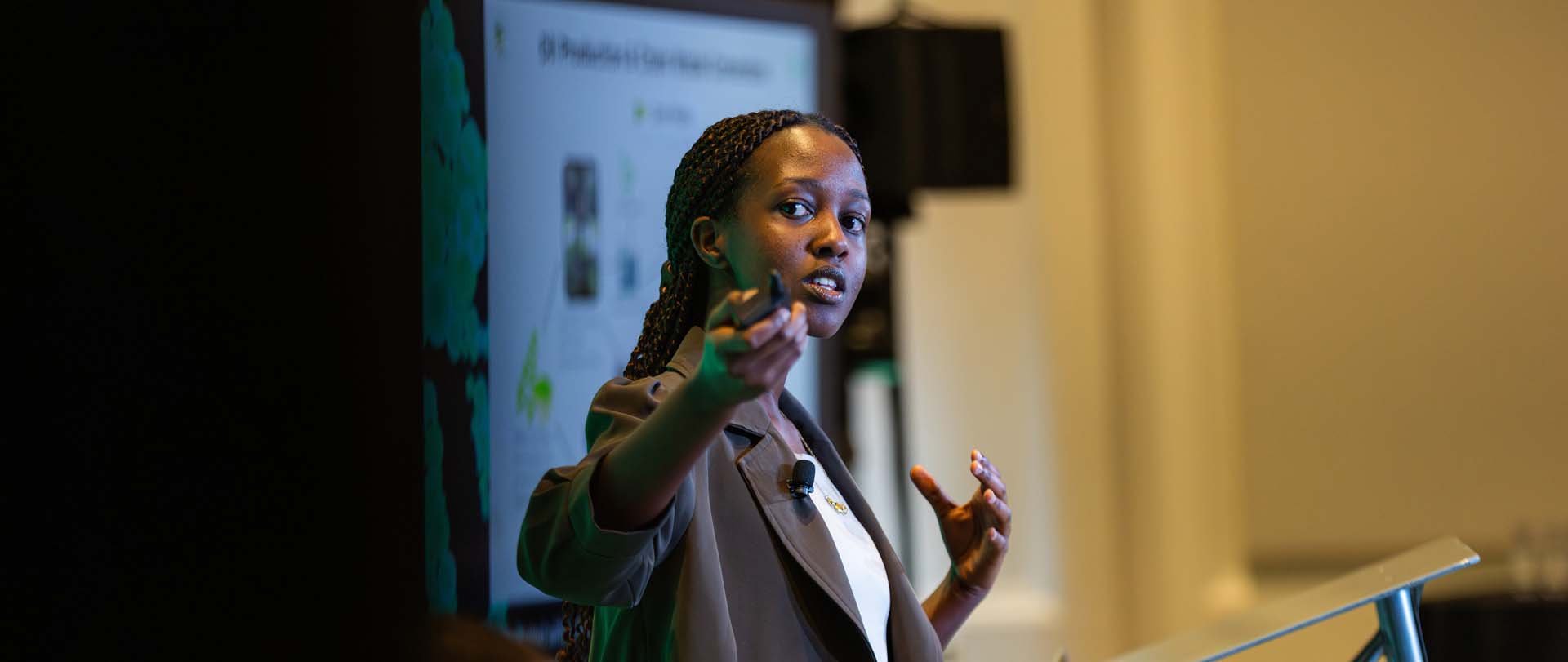
Three student teams whose members all hail from Africa clinched the top spots at the finale of international design competition Wege Prize 2026 in an inspiring display of what innovation, determination, teamwork, and passion can accomplish with astute guidance.
Organized by Ferris State University’s Kendall College of Art and Design, Wege Prize 2026 demonstrated how young interdisciplinary teams of entrepreneurs dedicated to generating sustainable, scalable business models are leading by example, teaching how to create game-changing solutions to today’s “wicked problems” using the three core principles of the circular economy: designing out waste and pollution, ensuring circularity of products and materials, and regenerating natural systems.
At the recent 2026 Wege Prize Awards, five finalist teams presented solutions developed over nine months in four competition phases, during which teams interacted with Wege Prize judges to receive in-depth feedback for refining ideas and plans.
Shaped by their experience growing up together in Kenya’s Kakuma Refugee Camp, Nutri-Más—a team of students from South Sudan—won first place and $30,000 with a project to transform one of their home country’s most persistent sources of water contamination into a circular solution to address the issue of childhood malnutrition.
The team is taking whey, which is typically discarded by dairy producers and goes on to pollute key water sources, and blending it with locally grown sorghum, maize, and groundnuts to create an affordable and nutrient-dense composite flour for everyday cooking.
The Wege Prize judges noted the circularity inherent in the Nutri-Más solution, which closes loops and builds circularity to tackle two substantial problems at once.
“The judges were also moved by the Nutri-Mas story,” said Gayle DeBruyn, a Ferris State professor on the Wege Prize organizing team. “Bonded since youth, all five were raised together in a refugee camp after fleeing South Sudan, and together they are channeling their resilience and collective ingenuity to address the same crisis that once forced them from their homes.”
Judge Joaquin Viquez, an educator, social impact leader, and entrepreneur whose company Innovaciones Circulares is revolutionizing nutrient management in agriculture, said he applauds the fact that the Nutri-Más solution has a local focus with local resources led by local people.
“The team has created an impressive framework of empowerment for everyone involved in order to tackle malnutrition early on," he said.
Nutri-Más plans to use their prize winnings to continue scaling their solution over
the next five years.
"We aim to start with 500 children impacted in the first year and reach at least 1
million children in the fifth year; to grow from working with 10 farmers to 500; and
to continue creating jobs for the community in Soth Sy, starting with 7 and reaching
500 employment opportunities in year five," said team leader and presenter Angelina
Wel Wech, studying Agriculture Sciences at EARTH University in Costa Rica. "Through
all the mentorship along the way, and now winning 1st place, Wege Prize has unlocked
this dream for us."
The winning solutions have drawn attention to Wege Prize 2027 as its start draws near. The application period opens on Aug. 2026, and teams from around the world are expected to compete.
Each sharing in the competition’s $65,000 prize money, the five 2026 finalist teams emerged from an initial pool of 87 teams of five, representing 35 countries, 126 institutions of higher learning, and 195 distinct disciplines. After months of research, learning from expert judges, and clever experimentation, these five groups emerged from the initial field, earning top honors and cash prizes for their creativity, dedication, and hard work.
Second-place finishers Team Agri Nova earned a $20,000 prize for developing a modular, low-impact, farming system to enable year-round production of grasshoppers, from which a protein-rich grasshopper oil can be extracted creating a much-needed, low-cost source of critical nutrition for low-resource communities.
Third-place finisher Team Egret Pads earned $10,000 with a plan for turning banana crop waste into affordable, biodegradable sanitary pads for women in Rwanda's low-resource communities, creating dignified access to menstrual health through a circular system that empowers women, supports farmers, and returns used pads back to the soil as fertilizer.
Team Ecoscrubber was a finalist and earned $2,500 by creating a hybrid emission control and carbon-capture system designed to eliminate toxic pollutants and greenhouse gases from incinerators while transforming captured residues into valuable construction materials.
UniThread EcoHusk earned $2,500 as a finalist for reimagining discarded cocoa husks—which degrade soil and harbor pests and disease when left to rot—as raw materials for activated charcoal-based purification kits that can keep 95% of textile dye pollution out of water and wastewater streams.
Ferris State’s DeBruyn said seeing all five of this year’s top circular economy solutions coming from Africa was exciting, and that how their projects evolved and grew under the judges’ guidance has led to viable pioneering pathways towards a circular economy.
“Each is regenerative, restorative, and intentional when compared to the traditional, linear extract-produce-dispose model,” she said. “Our hope is that teams forming now around the world for Wege Prize 2027 are taking note and learning from the inspiring examples of our finalists hailing from Africa.”
Wege Prize solutions regularly make real-world impacts and importantly creating ripples of value beyond the solutions themselves. Turning the attention of potential leaders and changemakers to creating a circular economy seeds industries of all kinds in all sectors worldwide with talented, passionate young innovators and entrepreneurs who embrace, and bring with them, new ways of thinking, visioning, and collaborating across disciplines.
Most famously the 2023 Wege Prize winning team Banana Leather has since grown their submission into Banofi Leather, a manufacturer of a bio-based leather alternative made from banana crop waste that has garnered global media attention and won the prestigious and lucrative Hult Prize.
Rutopia, the winning team of Wege Prize 2018, also earned Hult Prize honors for its comprehensive solution for creating tourism opportunities in Mexico that help regenerate nature and sustain small rural economies with unique and authentic experiences for travelers.
Both Jinali Mody and Emiliano Iturriaga, leads of Banana Leather and Rutopia, respectively, have each earned spots in the Forbes 30 Under 30 list.