June 9, 2026
Online learning to real-world experience: Ferris State HVACR and Energy Management programs host summer laboratory experiences
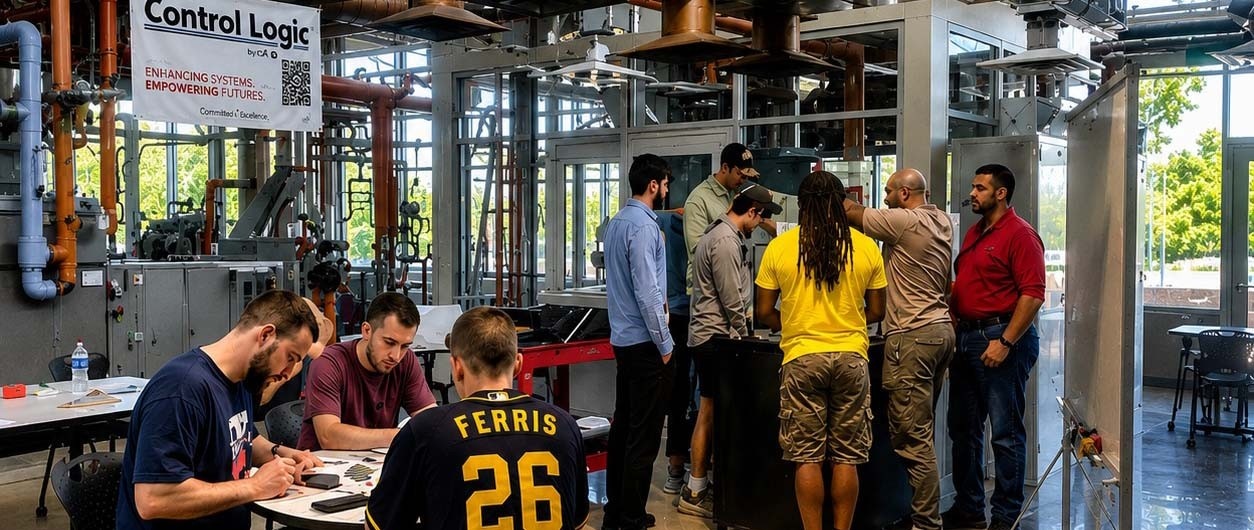
Students from across the country are visiting Ferris State University’s Granger Center for Construction and HVACR this month to participate in summer laboratory sessions, providing in-person, hands-on experiences to go with their online learning.
Ferris State’s Granger Center for Construction and HVACR provides an ideal learning environment by combining visual instruction with hands-on experience for students studying heating, air conditioning, and refrigeration.
Distance-learning students in the HVACR Engineering Technology program travel to campus each summer for an intensive five-day laboratory session focused on HVACR systems and controls within the energy lab.
The labs are part of the requirements for HVAC 314, taught by assistant professor Ryan Kauffman, and HVAC 323, taught by associate professor Gerry Lucas.
Lucas highlighted the value of combining online instruction with hands-on laboratory experiences.
“The online HVACR Engineering Technology program provides students with the flexibility to continue advancing their education while balancing professional and personal responsibilities,” he said. “Students gain valuable technical knowledge through online coursework and strengthen those skills through hands-on laboratory experiences at the Granger Center.”
During their time on campus, students gain practical experience in fluid measurement,
heat transfer, control programming, loop tuning, and system commissioning. These immersive
laboratory experiences reinforce classroom concepts while preparing students for success
in the evolving HVACR industry.
Lucas emphasized the impact of the summer laboratory sessions on student success and
career preparation.
“The five-day laboratory experience at the Granger Center is one of the most rewarding parts of the program,” he said. “Students have the opportunity to apply classroom concepts in a real-world environment while working directly with HVACR systems, controls, and industry technology. This blended learning experience helps prepare students for continued success and advancement within the HVACR industry.”
Employment for HVACR mechanics and installers is projected to grow 8% to 9%, which is faster than the average for all occupations.
The U.S. Bureau of Labor Statistics projects around 40,100 annual job openings on average over the coming decade, driven by ongoing commercial and residential construction and a push for energy-efficient systems.