

June 18, 2026
Ferris State's College of Engineering Technology named a Michigan hub for free, career-building CNC machining program
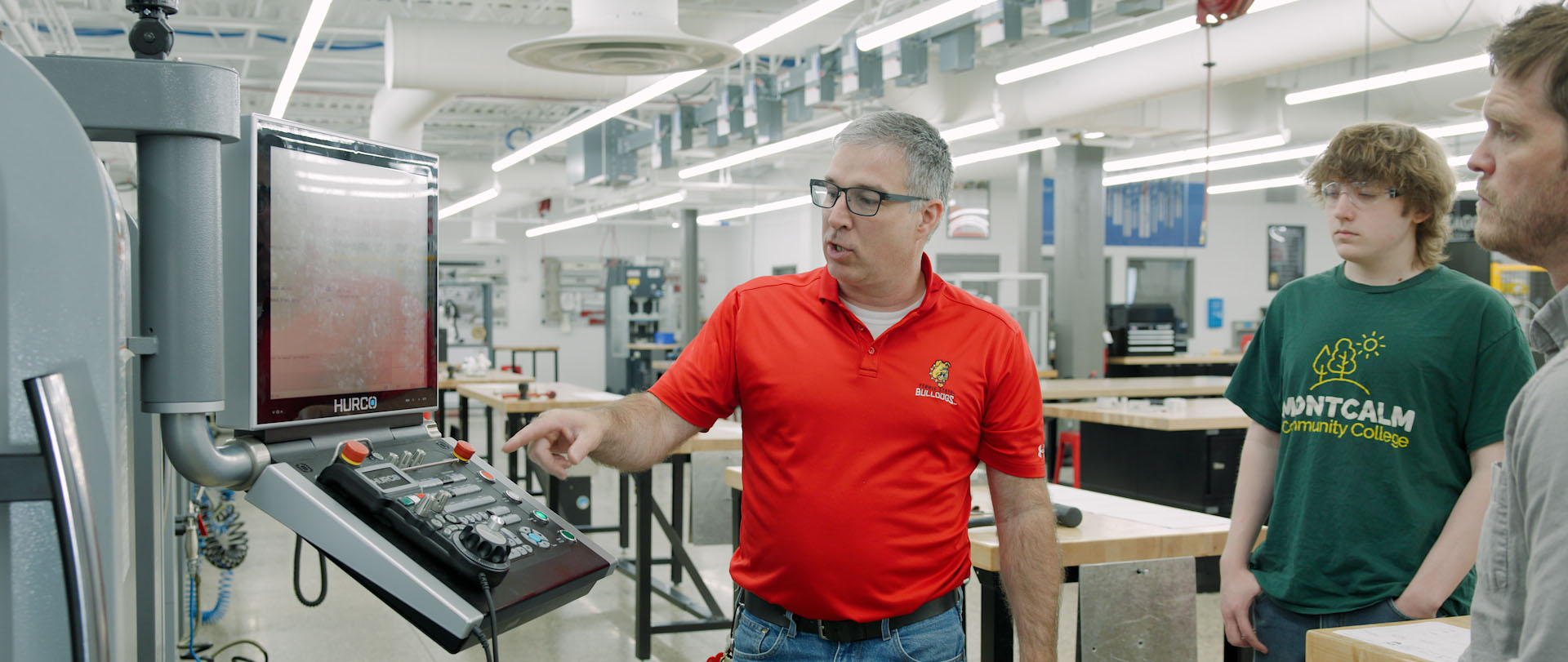
Ferris State University's College of Engineering Technology is one of only two Michigan hubs for America's Cutting Edge, a federally funded national program to rebuild the machine tool workforce through free computer numerical control machining training.
The program's first “bootcamp” began Monday in Big Rapids. A second is planned for Aug. 10 to 15, and space is still available.
The one-week, 40-hour training is free, open to anyone 16 and older and requires no prior machining experience. Participants complete six to eight hours of free, self-paced online coursework first, then report to the Swan Building on campus for hands-on CNC training under a strict 5-to-1 student-to-instructor ratio.
"The whole mission of this program is to generate interest in the machining trades," said Mark Prosser, director of Ferris State's School of Design and Manufacturing.
Bootcamp completers earn an America's Cutting Edge badge and 2.75 continuing education units. Ferris State is also developing a one-credit prior learning class that would allow participants to apply the training toward a college credential.
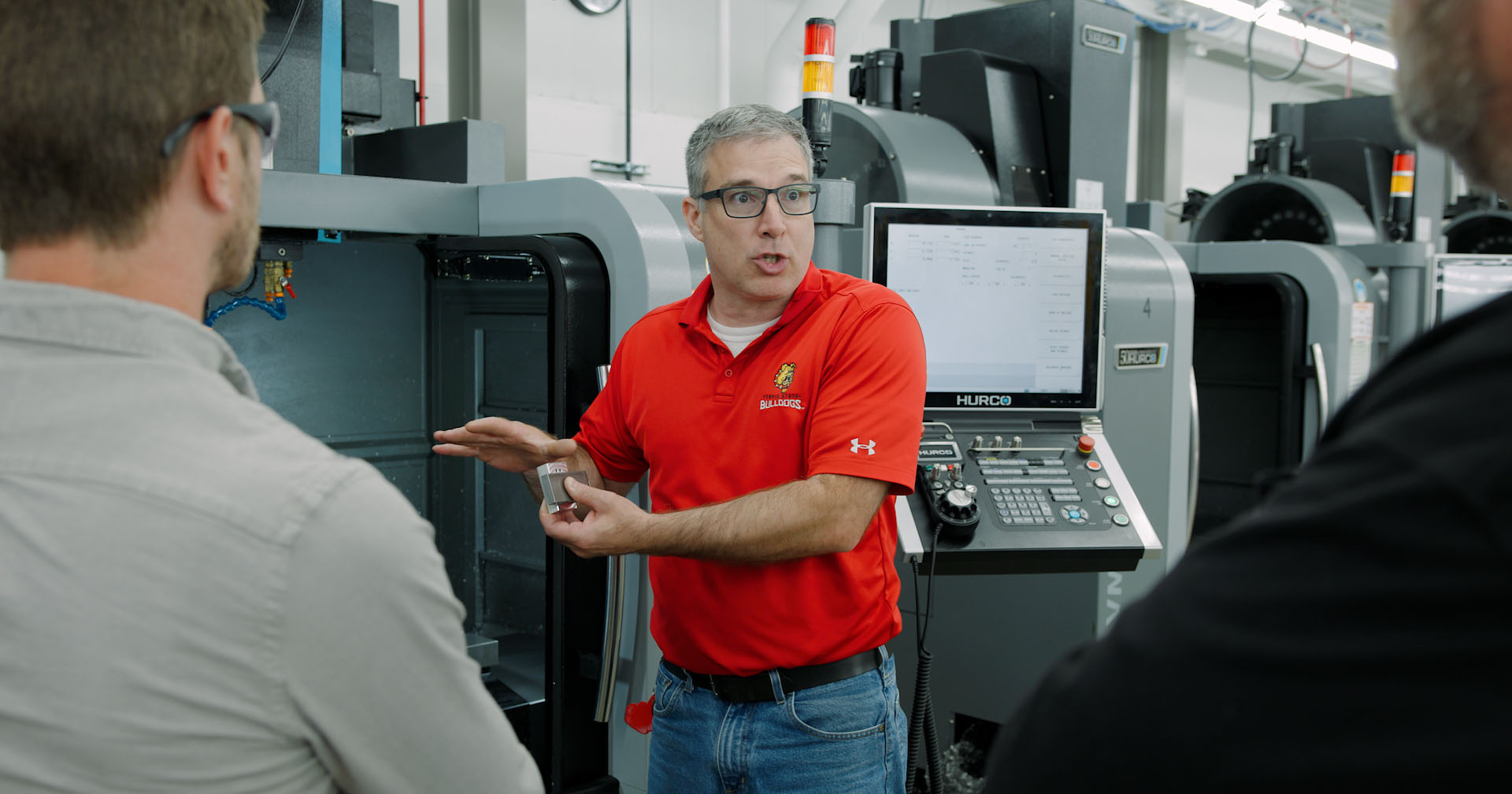
America's Cutting Edge, supported by the U.S. Department of War’s Industrial Base Analysis and Sustainment Program and managed by IACMI — The Composites Institute, addresses a measurable and growing shortage.
About 30,000 machining companies across the country struggle to find skilled operators, engineers, and designers. In West Michigan, that shortage translates to overworked employees and a thinning pipeline as experienced machinists retire.
"Companies are hungry," said Pat Doherty, an ACE instructor in Ferris State's School of Design and Manufacturing. "Those that are skilled are working longer hours, more jobs, and so there's a risk of burnout. Plus, as people are retiring, we're losing them."
Doherty said the industry's deeper problem is public perception.
"The biggest skill gap is perception about machining," he said. "When you think of a machine shop, you think of this dark, dank thing with coolant dripping off the I-beams, when in truth, that is very far from what current advanced manufacturing is."
Modern CNC machining runs on software. Machinists program machines using computer-aided manufacturing tools such as Mastercam and Fusion 360, monitor automated processes and measure finished parts against engineering specifications. American manufacturing workers earn an average of $95,990 in combined pay and benefits.
"You could be inside on your computer all day, doing the CAM work," Doherty said. "It's not dirt, dark, dank, dirty like it used to be. It's pretty clean. It's pretty tech filled."
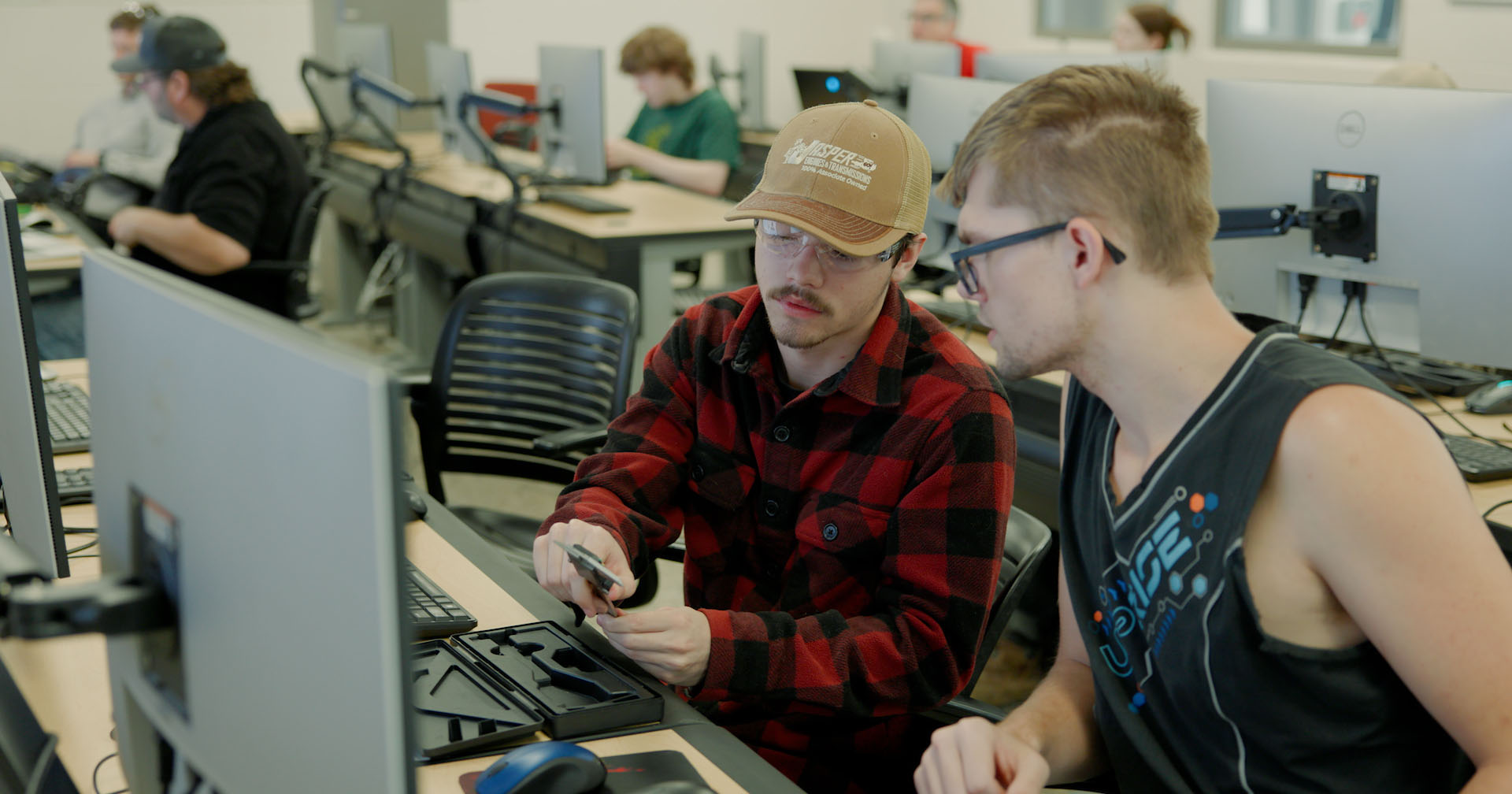
Doherty and associate professor Dean Krager split each cohort in half on the first day. One group begins computer-aided manufacturing in the classroom — learning toolpath a part on screen. The other heads to the lab to set up a CNC machine using probing technology and establish workpiece coordinates. Then the groups swap: each participant runs the part they just programmed and programs the part they just ran.
Each subsequent day adds new skills. Participants move from milling to turning to metrology, learning to measure finished parts against engineering prints. A train-the-trainer structure runs throughout: after an instructor demonstrates a process, participants teach the next step to each other, with Doherty or Krager available for technical questions.
On the final day, participants assemble the five components they machined during the week into a functional air pump, engrave a Ferris State logo on the back and take the finished product home.
"By the end of it, are they going to be experts in CNC? No," Doherty said. "But hopefully they're exposed and they go, 'Huh, I can do CNC, I do like this — machining is pretty cool.'"
IACMI — The Composites Institute evaluates potential partner sites on facility quality and instructor expertise before formalizing hub agreements. An IACMI technical representative flew from Tennessee to tour Ferris State's machining labs and called the facility among the best he had seen across the national network, which now spans more than 20 universities and community colleges.
ACE funded touch and tool probing upgrades on all the College's CNC machines as part of the partnership. Doherty and Krager traveled to Tennessee over spring break for a weeklong train-the-trainer session, earning certification to lead bootcamps and to train instructors at future spoke sites.
Prosser said Ferris State's national reputation drove the selection.
"The nationally recognized reputation that we have for training skilled people in these areas — that's probably the big one," he said.
That reputation rests on more than 50 years of applied technical education. Ferris State launched its first Machine Tool certificate and degree programs in 1970, and the College of Engineering Technology has built on that foundation across four schools: Automotive and Heavy Equipment, Built Environment, Engineering and Computing Technology, and Design and Manufacturing.
The School of Design and Manufacturing alone offers eight Bachelor of Science and six Associate of Applied Science degrees — spanning Manufacturing Technology, Welding Engineering Technology, Computer-Aided Design and more — all taught by faculty who bring direct industry experience into the classroom.
Doherty said the fit runs deeper than credentials.
"It kind of gets back to Ferris's roots — Ferris Industrial School," he said. "We're getting back to what Ferris was actually created for way back when."
As a hub, Ferris State manages the ACE program across Michigan’s lower peninsula. When additional institutions or employers join as spokes — sites with qualifying equipment and instructors — their student counts, budgets and compliance reporting route through Ferris State. Doherty and Krager serve as regional resources for spoke sites that need support or additional training.
"They just want us to train as many people and get as many spokes as we can," Doherty said.
Ferris State entered the partnership with a first-year goal of 20 students. The program is on pace to clear that target within its first two months — well ahead of the three-year contract timeline. The College of Engineering Technology currently offers the CNC machine tooling track, and Ferris State is exploring additional ACE tracks for future contract years.
Individuals 16 and older can register at AmericasCuttingEdge.org. Those with questions can email [email protected].