January 28, 2026
From classroom to catalog: Ferris State Astronomy research adopted by U.S. Naval Observatory for researchers around the world
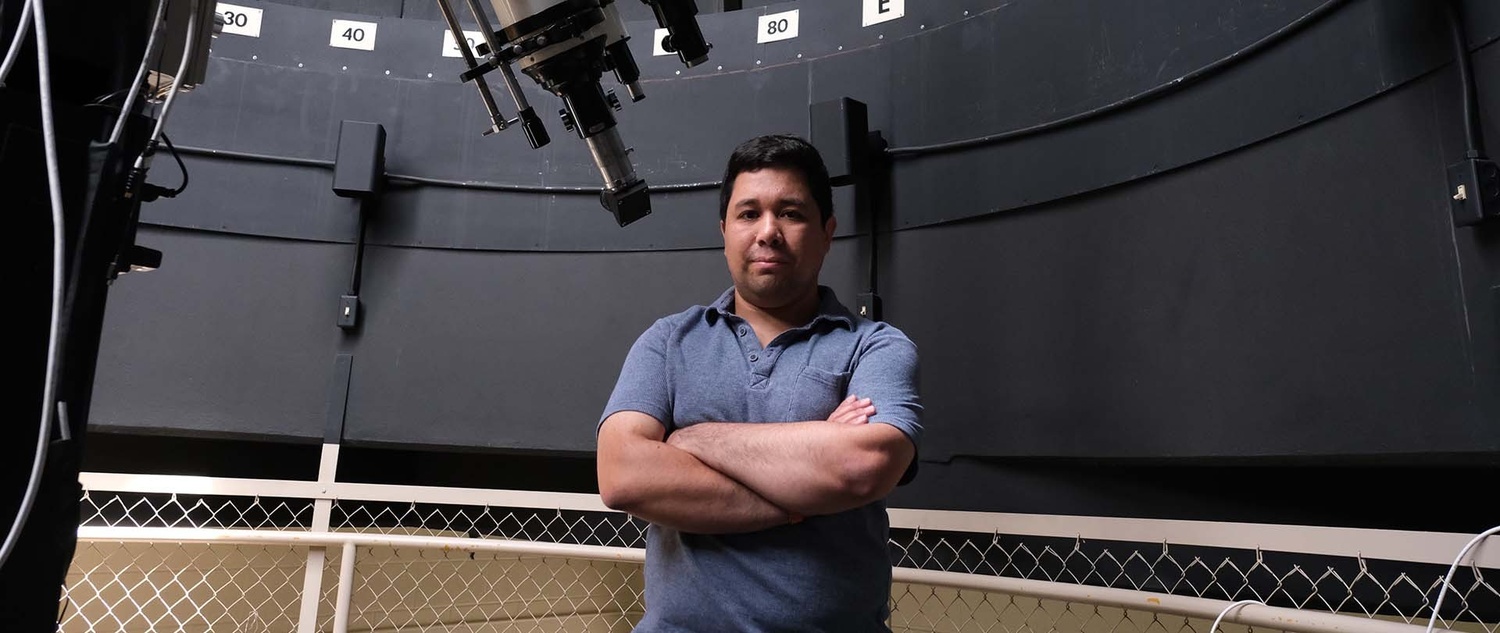
Ferris State University professor Dinesh Shetty and student Francisco Vasquez achieved a significant milestone in astronomical research, with four of their newly developed binary-star orbital models adopted by the United States Naval Observatory.
Their work is now permanently archived in one of Astronomy’s most important reference catalogs and can be used by researchers around the world.
What began as a student project has become part of the scientific record—demonstrating the power of hands-on research and undergraduate-focused scientific training at Ferris State.
The research originated during the summer of 2024, when Shetty and Vasquez observed six known binary star systems. Their analysis resulted in new orbital solutions that were published in the Journal of Double Star Observations on Jan. 1, 2025.
Following publication, the USNO in January 2026 incorporated four of these orbital models into the Sixth Catalog of Orbits of Visual Binary Stars, replacing earlier solutions developed by professional astronomers over the past 30 years.
The catalog is the world’s authoritative reference for visual binary star orbits and is widely used by astronomers internationally.
“Contributing new ephemerides to the sixth Orbital Catalog is especially meaningful because it reflects years of careful observation, analysis, and collaboration,” said Shetty, who teaches Physics and Astronomy. “It’s rewarding to see that work become part of a resource the broader astronomical community relies on.”
Binary stars—systems in which two stars are gravitationally bound—play a crucial role in astrophysics. By modeling their orbits using Kepler’s Laws, astronomers can determine stellar masses, the most fundamental parameter for understanding stellar structure, evolution, and lifecycles.
Only a few thousand such systems have been confirmed, making each refined orbital solution scientifically valuable.
“Every improved orbit helps refine our understanding of stellar masses,” Shetty said. “And that feeds into nearly everything we know about how stars and planetary systems form and evolve.”
Vásquez, a native of Quilpue, Chile, was one of 14 Student Fellows collaborating with Ferris State faculty mentors on research in 2024.
He used the fellowship to further his interest in astronomy, which has taken him to observatories and astronomical symposiums in Poland, studies at the Tololo Observatory in Chile, participation in the ALMA Radiotelescope project in Chile, and visits to NASA’s Kennedy Space Center.
He earned the outstanding student research award last year from Ferris State’s Office of Research and Sponsor Programs as part of the 2025 Celebration of Scholarly and Creative Works event.
“This is a great example of how mentored undergraduate research, valuable one-on-one interactions between faculty and students, can lead to successes both inside and outside the classroom”, said Dr. Thomas Dowling, director of Research at Ferris State. “We are working on ways to promote these high impact practices widely across campus and support faculty as research mentors. These are truly valuable opportunities for students going forward.”