
HLC Accreditation Status
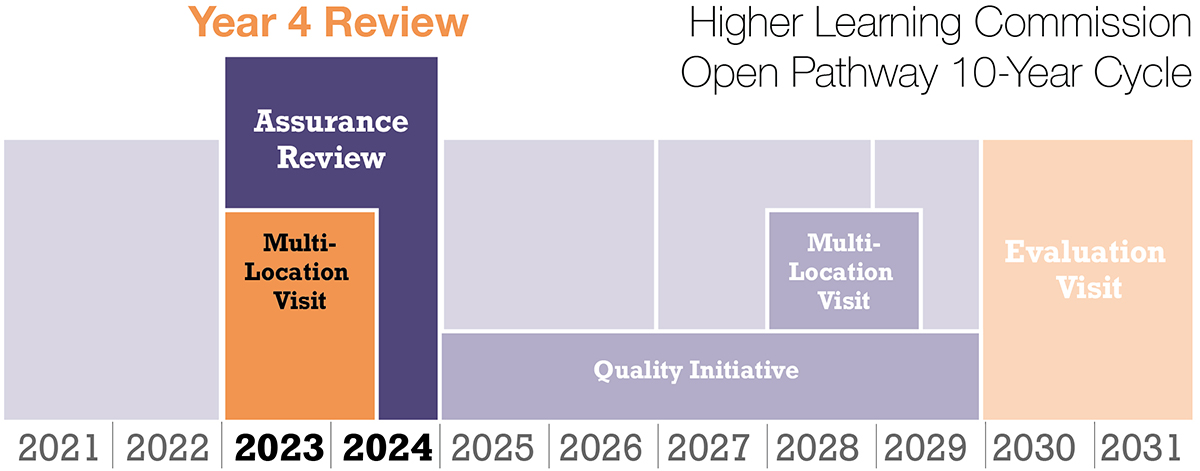
From April 18-20, 2011, Ferris hosted the Higher Learning Reaccreditation Visiting.
As a result of that review, Ferris' accreditation was extended for ten years until
2020-2021 with no follow-up reports required.
The successful self-study process that culminated with a visiting team in April of
2011 began in the fall of 2007. This effort was authorized by the President and the
Board of Trustees and was capably chaired by (former) Associate Vice President of
Student Dr. Michael Cairns and Arts & Sciences faculty member Dr. Christine Vonder
Haar. Dr. Sandra J. Balkema served - for the third time - as the overall writer/editor
for the self-study at Ferris. Overall coordination of the self-study process was
the responsibility of the Office of Academic Affairs with Associate Provost Dr. Roberta
Teahen and Administrative Assistant Maureen Milzarski.
Representative compliments/comments from the Team's Report include these:
- The integrity of the process of preparing the self-study was reflected through the
organization of the Self-Study Steering Committee. In addition to the faculty and
administrators who served on each of the criterion subgroups, all campus administrators
were involved in preparations of the self-study.
- Conversations with faculty, staff, and board members clearly show that they have a
shared understanding of the mission.
- The concept of diversity and inclusion is evidenced across the university and is interpreted
broadly, including cultures, gender and gender orientation, religion, disabilities,
beliefs, and ideas. It is evident in the curriculum designed to advance knowledge,
understanding, and appreciation of current and future constituencies as well as preparation
for a global society, global perspectives, and a diverse world.
- Components of the mission were heard by the Team in explicit statement made by faculty,
staff, and students using terms like the "inherent dignity" of everyone at Ferris
and a commitment to promoting "fairness, honesty, and integrity."
- Ferris State University demonstrates that its planning processes are congruent with
the larger institutional mission, realistic without precluding the launching of strategically
important initiatives, and appropriately careful about and sensitive to the demands
emanating from a turbulent larger environment.
- The audited financial statements of Ferris State University make it clear that the
institution is on solid financial ground. While the University has not been immune
to the effects of economic recession in the state and the nation, especially between
mid-2008 and late 2009, available cash and cash equivalents appear to be quite capable
of sustaining university operations.
- Evaluation of programs and activities at Ferris State University occurs in a wide
variety of contexts and units. On the academic side, programs are reviewed on a six-year
cycle by the Academic Program Review Council (APRC) of the Academic Senate. These
reviews are intensive, and the recommendations they produce are forwarded to the Academic
Senate, the Provost, the President, and the Board of Trustees.
- The Faculty Center for Teaching and Learning (FCTL) is a prominent feature of Academic
Affair at FSU. Besides new faculty support and support for online instruction, initiatives
of the FCTL which are focused on effective teaching include a "Focus on Student Success"
program and a Scholarship of Teaching and Learning program which sent 10 faculty members
to a State Teaching and Learning conference in 2010.
- It was clear from open and targeted meetings that many non-classroom employees are
well-informed and value and take student learning at FSU seriously. Employees are
industrious about learning about what is happening across the university and make
their voices heard.
- The physical facilities that house the special purpose laboratories and clinics provide
state-of-the-art learning experiences for many Ferris State University students.
Of particular note is the new building housing the Michigan College of Optometry which
opened this year. The building design is innovate and flexible and will serve students
and faculty well into the 21st century.
- Across campus, Ferris State University supports and maintains an elaborate array of
additional laboratory and support resources to facilitate student learning. These
include: the Academic Support Center, the Writing Center, and Structured Learning
Assistance (SLA) courses, which are linked to high-risk-for-failure courses. The
SLA courses have improved student retention in programs in allied health.
- The institution has demonstrated a strong commitment to diversity and social responsibility
in the appointment of a vice president in support of diversity as well as a variety
of other programs and activities such as the Annual Diversity Enhancement Award, the
Institute for the Study of Academic Racism, and the Jim Crow Museum. In addition,
program outcomes including the general education outcomes reflect an ongoing commitment
to social responsibility.
- Evidence from interviews (both individual and group), self-study documentation, and
meeting with advisory councils suggests the institution has a strong commitment to
keeping the curriculum current and relevant. Internships, clinical placements, and
field experiences are found in almost every program at FSU. Particular attention
has been made to addressing the ongoing concerns of professionals in the field and
prospective employers. The College of Professional and Technological Studies coordinates
a wide range of continuing education and professional development opportunities for
area professionals.
- Ferris State University clearly is engaged in a variety of productive partnerships.
Academic departments could point to specific relationships with local government agencies,
small businesses, and mid- to large-size corporate entities that were connected to
the university's human assets through service learning, internships, and civic or
community engagement activities. For example, the staff in the Faculty Center for
Teaching and Learning could identify faculty, courses, and development programs that
are focused on service, with financial and intellectual support provided through the
Center, various colleges, and Academic Affairs. The curriculum similarly supports
the academic message of engagement, leadership, and learning through the FSUS 100
course.
Prominent among the suggestions for continuing improvement at the university are these:
- Assuring more consistency across programs in implementation of assessment and the
use of assessment data to inform program and course improvements that will further
enhance student learning.
- Increasing emphasis upon scholarship among the faculty, particularly as it relates
to graduate education.
- Investing in technology infrastructure for support of expansions in online learning.
Review the University's Statement of Affiliation status here.
Higher Learning Commission
Contact: Roberta Teahen, Ph.D.
Associate Provost of Accreditation, Assessment, Evaluation and Compliance
Ferris State University
1201 S. State Street, CSS 310
Phone: 231-591-3805
Contact: teahenr@ferris.edu